Showing posts with label Sherlock Holmes. Show all posts

Tuesday, November 21, 2023

An Article for Fellow Book Lovers: 10 Books That Made Us…And 5 Others That Also Helped (Denny & Claire Hartford)

As I mentioned in a recent Book Den post (October 31), I finished a most enlightening and relevant book entitled 10 Books that Screwed Up the World: And 5 Others That Didn’t Help by Benjamin Wiker. That book easily makes my Top 10 for the year and I couldn’t recommend it more highly for those who want to know more about why Western Civilization has so tragically “devolved” in the last century. I truly hope many of you will take the challenge and read it yourself.

But reading that book also prompted Claire and me to think about the books that had actually made the world better -- at least, our world. We decided to make it a project, one that would cause us to look back, remember, and evaluate the books that had most shaped our lives for the better. It proved to be a very worthwhile exercise for us both and we have decided to share it. We hope you find our answers of interest even as we suggest that you consider pondering a similar experiment. So, let’s go. Aside from the Bible itself, we are going to tell you the 10 Books That Made Us…And 5 Others That Also Helped. 

You'll find that piece on the Vital Signs Ministries website right here.

Friday, March 17, 2023

Heroes in My Library

My library is a special place to me, in part, because it is a place where many of my heroes await meeting with me.  You remember heroes, don’t you?  Those men and women who bravely fought for great causes, sacrificed for lofty ideals, and otherwise broke the bonds of compromising commonality to achieve noble aims.  In addition to my faith in Jesus Christ and my dependence on the Holy Spirit, in addition to my zeal to study the Bible and carefully learn its revelations and precepts, I’ve joyously accepted the gifts God has given me in mortal heroes. And I've cherished the inspiration they have brought me throughout my life -- heroes whose exemplary character and deeds of physical and moral valor compel me to dream bigger, reach further, and relish more the adventures of life.

My library resounds with the presence of these heroes and, even after decades of friendship, I still appreciate my every encounter with them. They include the apostles, Luke the physician, Alexander Solzhenitsyn, Christopher Columbus, Ronald Reagan, Francis & Edith Schaeffer, Ulysses S. Grant, St. Patrick, Clarence Thomas, G.K. Chesterton, Old Testament heroes like Joseph and Kings Hezekiah and Josiah, Thor Heyerdahl, Edith Cavell, C.S. Lewis, Audie Murphy, Joni Eareckson-Tada, Malcolm Muggeridge, Paul Tournier, Florence Nightingale, Samuel Eliot Morison, William Wilberforce. The list goes on.

Even the fictional heroes in my library are trusted friends: Sherlock Holmes, Sydney Carton, the Count of Monte Cristo, Robin Hood, Fr. Brown, Richard Hannay, Robinson Crusoe, Badger and Ratty, D’Artagnan and the Musketeers, Mr. Pickwick, the Scarlet Pimpernel, Fr. Tim Kavanagh, Elwin Ransom, Ivanhoe, Horatio Hornblower, Frodo and Sam, the converted Ebeneezer Scrooge, Sir Wilfred of Ivanhoe, and so many others. The Lord uses even these “invented heroes” to yet provide real-life inspiration and direction.

Heroes have shaped my life in ways too numerous and deep to ever fully realize. They have daringly challenged me to venture outside my comfort zones and narrow self-interests and instead embrace the adventurous opportunities life provides for character, integrity, courage, and religious faith.

Where would I be without heroes? I don’t want to even imagine.

Catching Up: A Brief Review of First Quarter Reading.

Yes, the first quarter of 2023 is drawing to a close and I realize I’m behind schedule in reviewing and recommending books from my recent reading. So let me make it short and sweet. First of all, my reading is lagging behind a bit because of other things crowding into the schedule -- preparation for several sermons, preparation for a couple of lectures at a L’Abri Conference, trips to Kansas and Minnesota, and a busier schedule of “When Swing Was King” and other Vital Signs happenings. Still, I’ve very much enjoyed those titles I did get to.

As you may know, a great deal of my reading has always been re-reading. And that trend actually increases as I age. Even as I have favorite foods (hamburgers and grilled peppers, bacon and eggs) that I eat over and again; even as I have favorite haunts (the Colorado mountains, Branson) that I visit over and again; and even as I have favorite friends that I make it a habit to hang out with; so I am delighted to re-visit my favorite books.  

I’m in good company with this practice.

C.S. Lewis wrote in On Stories: And Other Essays on Literature, “An unliterary man may be defined as one who reads books once only…We do not enjoy a story fully at the first reading. Not till the curiosity, the sheer narrative lust, has been given its sop and laid asleep, are we at leisure to savour the real beauties. Till then, it is like wasting great wine on a ravenous natural thirst which merely wants cold wetness.”

And in An Experiment in Criticism, Lewis explained his convictions this way, “The majority never read anything twice. The sure mark of an unliterary man is that he considers ‘I’ve read it already’ to be a conclusive argument against reading a work…Those who read great works, on the other hand, will read the same work ten, twenty or thirty times during the course of their life.”

Therefore, with such standout encouragement, I’m not bothered to say that of the 17 books that I’ve read so far in 2023, 16 of them were re-reads. They included the full “canon” of Arthur Conan Doyle’s Sherlock Holmes (the 4 novels and the 5 collections of short stories): A Study in Scarlet, The Sign of Four, The Adventures of Sherlock Holmes, The Memoirs of Sherlock Holmes, The Return of Sherlock Holmes, The Hound of the Baskervilles, The Valley of Fear, His Last Bow, and the The Case Book of Sherlock Holmes.

There were also a couple of terrific adventure novels in that re-read pile (Robert Louis Stevenson’s The Master of Ballantrae and Rafael Sabatini’s Scaramouche); Karel Capek’s insightful play from 1920, R.U.R.; and 4 of Shakespeare’s “history” plays (Henry VI Part One, Henry VI Part Two, Henry VI Part Three, Richard III.)

And the only new work? Well, it was an exceptional one, The Politically Incorrect Guide to Western Civilization by Anthony Esolen. You’ll probably find me posting quotes from Esolen’s book on my Facebook page for some time. Plus, it made me eager to read other books he’s written. He’s relevant, accurate, insightful, wise, spiritually tuned in, and a wonderful writer. 

I recommend the Esolen book as highly as I can. And, yes, all of the others rate several stars as well. 


Saturday, December 31, 2022

Ending 2022’s Reading: A Review, Recommendations, and Resolutions

The year 2022 was not a record year for my reading – there was too much time taken up with vertigo recovery, our care for Carol Coppi, our involvement with my little sister in Wichita, and the ever-busy tasks of Vital Signs Ministries. And, alas, my reading took a pretty big hit with the ending of the Notting Hill Napoleons, our remarkably stimulating book club of 30 years. However, I still managed to slip in 6 dozen. 

As usual, many of these books were re-reads as I thoroughly enjoyed checking in again with such dear, lifelong friends as Alexander Dumas, Rafael Sabatini, Samuel Eliot Morison, C.S. Lewis, Robert Louis Stevenson, Jan Karon, G.K. Chesterton, John Buchan, William Shakespeare, Michael Ende, Edna Ferber, Owen Wister, Joni Eareckson Tada, Bess Streeter Aldrich, and Charles Dickens. 

But I made some new friends in 2022 too. Hunting the Nazi Bomb by Damien Lewis, Your Time Is Now by Jonathan Evans, Seven Men of Gascony by R.F. Delderfield, The Admirals by Walter Borneman, Created Equal (Clarence Thomas in His Own Words) edited by Pack and Paoletta, Johnny Tremain by Esther Forbes, The Apostate by Mark Christian, and The Book of Signs by David Jeremiah. All of the above titles made 4 stars in my ratings and are therefore enthusiastically recommended to you all. 

So there you have a very brief review plus a few recommendations. How about the resolutions then? Well, even now I have begun re-reading the several books connected to a seminar I’m presenting at the Rochester L’Abri’s annual conference on February 17 & 18. That presentation is entitled Beware the Mad Scientist: Divine Warnings Against “Playing God” from Classic Literature and it will cover Frankenstein by Mary Shelley, The Island of Dr. Moreau and The Invisible Man by H.G. Wells, 20,000 Leagues Under the Sea by Jules Verne, Dr. Jekyll and Mr. Hyde by Robert Louis Stevenson, and Dr. Faustus by Christopher Marlowe.  

Beyond that project, my reading will most likely continue along regular routes. I will spend most of my reading time with those authors near and dear to me while occasionally investigating others.  Of course, I do have a few specific projects in mind (besides the L’Abri responsibilities) for 2023. They include my bi-annual reading of Heaven by Randy Alcorn; a few classic commentaries on books of the Bible by men like Harry Ironside; more Dickens and Shakespeare; a first time read of Robert Bork’s book The Tempting of America and George Gilder’s Men and Marriage; and jumping back into the stirring adventures of Sherlock Holmes, The Lord of the Rings, and The Chronicles of Narnia

Want to come along?

Friday, June 03, 2022

Everything I Needed to Know I Learned from Sherlock Holmes! -- Volume Four (of Four)

Let's see, Volume 4 of this series makes it a “Top Forty” of sage conclusions about life from the greatest of all detectives. 

Perhaps these quotations will take you in a hansom cab back through the fogs of London to the 21B Baker Street digs of Sherlock Holmes and Dr. John Watson where the game is always afoot.

And, for handy reference, here are the previous posts: Volume 1; Volume 2; and Volume 3.

1) “Crime is common. Logic is rare.”

2) “Some people without possessing genius have a remarkable power of stimulating it.”

3) “It is fortunate for this community that I am not a criminal.”

4) “As a rule, the more bizarre a thing is the less mysterious it proves to be.”

5) “Woman's heart and mind are insoluble puzzles to the male.”

6) “We can but try - the motto of the firm.”

7) “Idleness exhausts me completely.”

8) “An Eley's No. 2 [pistol] is an excellent argument with gentlemen who can twist steel pokers into knots.”

9) “There are always some lunatics about.”

10) “These are much deeper waters than I had thought.”

Tuesday, May 31, 2022

Everything I Needed to Know I Learned From Sherlock Holmes! -- Volume Three (of Four)

No, don’t worry. For those Baker Street Irregulars among you who haven’t yet had your fill of the great detective’s “points to ponder,” here are ten more from my catalog of Holmesian profundities. 

(By the way, the first two volumes are, respectively, here and here.)

1) “Mediocrity knows nothing higher than itself; but talent instantly recognizes genius.”

2) “It's a wicked thing to tell fibs.”

3) “Chloroform vapour does not help the palate.”

4) “Nothing clears up a case so much as stating it to another person.”

5) “Life is infinitely stranger than anything which the mind of man could invent.”

6) “When one tries to rise above Nature, one is liable to fall below it.”

7) “To a great mind, nothing is little.”

8) “All knowledge comes useful to the detective.”

9) “If a herd of buffaloes had passed along, there could not be a greater mess.”

10) “What object is served by this circle of misery and violence and fear? It must tend to some end, or else our universe is ruled by chance, which is unthinkable.”

Everything I Needed to Know I Learned from Sherlock Holmes! -- Volume Two (of Four)

Here’s the next installment of this series, being important “words to live by” from the greatest detective of all time.

(Oh yes; here’s Volume 1.)

1) “It is my business to know what other people don't know.”

2) “Work is the best antidote to sorrow.”

3) “Evil indeed is the man who has not one woman to mourn him.”

4) “It is better to learn wisdom late than never to learn it at all.”

5) “You can't play with edged tools forever without cutting those dainty hands.”

6) “Any truth is better than indefinite doubt.”

7) “Jealousy is a strange transformer of characters.”

8) “Dogs don't make mistakes.”

9) “I have investigated many crimes, but I have never yet seen one which was committed by a flying creature.”

10) “Our highest assurance of the goodness of providence seems to me to rest in the flowers. All other things, our powers, our desires, our food, are really necessary for our existence in the first instance. But this rose is an extra. Its smell and its color are an embellishment of life, not a condition of it. It is only goodness which gives extras, and so I say again that we have much to hope from the flowers.”

Monday, May 23, 2022

Everything I Needed to Know I Learned from Sherlock Holmes! -- Volume One (of Four)

During a lifetime of avid reading of Sherlock Holmes, the world’s greatest “private consulting detective,” I have learned many crucial lessons. In the next few days, I'll post here some of the most important. All are direct quotations of the profound Mr. Holmes as recorded, of course, by the ever-dependable Dr. Watson. Some you will find witty, some humorous, but you'll also be surprised at how morally profound some of these quotations are. Enjoy.

1) “When a man embarks upon a crime, he is morally guilty of any other crime which may spring from it.”

2) “A trusty comrade is always of use.”

3) “There is nothing more deceptive than an obvious fact.”

4) “I take a short cut when I can get it.”

5) “I can't make bricks without clay.”

6) “It is a capital mistake to theorize before one has data.”

7) “When a doctor does go wrong, he is the first of criminals.”

8) “Education never ends, Watson. It is a series of lessons, with the greatest for the last.”

9) “A man should keep his little brain attic stocked with all the furniture that he is likely to use, and the rest he can put away in the lumber-room of his library where he can get it if he wants it.”

10) “Your life is not your own. Keep your hands off it...The example of patient suffering is in itself the most precious of all lessons to an impatient world.”


Monday, April 29, 2019

On Re-Reading

“‘Tell me what you read and I’ll tell you who you are’ is true enough, but I’d know you better if you told me what you re-read.”  (François Mauriac)

“Curiously enough, one cannot read a book; one can only re-read it. A good reader, a major reader, and active and creative reader is a re-reader.”  (Vladimir Nabokov, Lectures on Literature)

These 2 quotes (and the one I post at the end from C.S. Lewis) prompted me to go back and scan my reading lists (those from the last 13 years were readily at hand) to ascertain just which authors and books are indeed my “go to” reads. I wasn’t surprised at the results. Indeed, the authors I’ve spent time re-reading in recent years were the authors with whom I’ve spent quite a lot of time all my adult life: Charles Dickens, C.S. Lewis, Alexander Solzhenitsyn, Francis Schaeffer, John Buchan, Alexander Dumas, William Shakespeare, J.R.R. Tolkien, James Thurber, Walter Scott,  Fyodor Dostoevsky, G.K. Chesterton, Malcolm Muggeridge, Randy Alcorn, Arthur Conan Doyle, Robert Louis Stevenson, Joni Eareckson Tada, Jane Austen, Paul Tournier, James Barrie, and such historians as Walter Lord, Shelby Foote, Samuel Eliot Morison, and Winston Churchill.

Oh yes, the most recent discovery to make this “best friends” list is Jan Karon. And what a wonderful addition she is.

I have a few other repeatedly-read authors, particularly in the “sheer entertainment” category which encompasses mysteries, adventure, and historical fiction. Among them are Agatha Christie, Dorothy Sayers, Ngaio Marsh, G.A. Henty, Erle Stanley Gardner, Alistair MacLean, C.S. Forester, John D. MacDonald, John Dickson Carr, etc.

Were there books that I re-read in this last 13-year period that came from authors besides my friends mentioned above? Yes, several in fact.  Laura Hillenbrand’s Seabiscuit. Michael Ende’s The Neverending Story. Thor Heyerdahl’s Kon-Tiki. Christopher Marlowe’s Dr. Faustus. Walter Wangerin’s The Book of the Dun Cow. Lew Wallace’s Ben-Hur. Baroness Orczy’s The Scarlet Pimpernel. Edmond Rostand’s Cyrano de Bergerac. U.S. Grant’s Memoirs. Thornton Wilder’s Our Town. Boris Pasternak’s Dr. Zhivago. Edward L. Beach’s Run Silent, Run Deep. Richard Adams’ Watership Down. Margaret Mitchell’s Gone With the Wind. Armando Valladares’ Against All Hope. Booth Tarkington's The Magnificent Ambersons.

Now I’ve known for some time that a good deal of my reading was re-reading. But this little experiment revealed to me just how much. The lowest percentage of re-reading in this 13-year period was just over 25% with the highest being just under 60%. The average in the latest 5 years is between 45-50%. But it is definitely climbing as the years go by.

I guess in my aging years I’m enjoying spending more time with old friends than with new acquaintances. C.S. Lewis seems to agree. “To me, re-reading my favorite books is like spending time with my best friends. I’d never be satisfied to limit myself to just one experience each with my favorite people.”

Monday, December 31, 2018

The Year in Books

It was another banner year for reading.

My booklist for 2018 finished this afternoon at 115 but that includes everything, including quickly-read mysteries and adventure novels. But along with the list itself I always keep a record of my responses. Those rating 4 stars are terrific books (many of them old friends) that I enthusiastically recommend to others. Those winning 3 stars are books of enjoyment and value that I would recommend in some circumstances and which might well merit a re-read at some time. The 2 star books are ones that I managed to finish but will probably never pick up again. And the 1 star books — well, actually, there are no 1 star books because if they’re that dull or offensive or annoying, I don’t bother to finish them and, therefore, they don't make the list. 

With all that said, though, 2018 was  a splendid year and I list below (by genre) all of my 4 star picks. (By the way, the ones with an asterisk are books that I had already enjoyed…at least once before. And, as you'll plainly see, with my advanced age and particular literary standards, I do a lot of re-reading!)

Novels:
* Ivanhoe (Walter Scott)
* The Hunt for Red October (Tom Clancy)
Before We Were Yours (Lisa Wingate)
* The Book of the Dun Cow (Walter Wangerin)
The Cruel Sea (Nicholas Monsarrat)
* Huntingtower (John Buchan)
* Killer Angels (Michael Shaara)
Fire Over England (A.E.W. Mason)
* The Man Who Was Thursday (G. K. Chesterton)
* The Magnificent Ambersons (Booth Tarkington)
Seventeen (Booth Tarkington)
* Little Dorrit (Charles Dickens)
* The Haunted Man (Charles Dickens)
* A Christmas Carol (Charles Dickens)
Emma (Jane Austen)
* The Wind in the Willows (Kenneth Grahame)
* The Christmas Room (Denny Hartford)
4 novels from Jan Karon’s delightfully engaging Mitford series, Out to Canaan, A New Song, In This Mountain, and Shepherds Abiding (Jan Karon)

Plays: 
* Our Town (Thornton Wilder), 
* Dr. Faustus (Christopher Marlowe)
* Cyrano de Bergerac (Edmund Rostand)
* The Love Girl & the Innocent (Alexander Solzhenitsyn)

Collections of Short Stories:
* King Arthur and the Knights of the Round Table (Antonia Fraser)
* The Adventures of Sherlock Holmes (Arthur Conan Doyle)
* The Memoirs of Sherlock Holmes (Arthur Conan Doyle)
* The Return of Sherlock Holmes (Arthur Conan Doyle)
* His Last Bow (Arthur Conan Doyle)
* The Casebook of Sherlock Holmes (Arthur Conan Doyle)
* Grimm’s Fairy Stories (The Brothers Grimm)

History: 
* The two volumes of Memoirs (Ulysses S. Grant)
Deadly Times: The 1910 Bombing of the Los Angeles Times and America's Forgotten Decade of Terror (Lew Irwin)
* Seabiscuit (Laura Hillenbrand)
The Quartet: Orchestrating the Second American Revolution, 1783-1789 (Joseph Ellis)

Christian Life/Culture:
* The Holy Bible (both a read-through AND a listen-through with Alexander Scourby’s narration)
* No Little People (Francis Schaeffer)
Happiness (Randy Alcorn)
* The Adventure of Living (Paul Tournier)
Creed or Chaos (Dorothy Sayers)
The Treasure Principle (Randy Alcorn)
The Best Is Yet to Come (Tony Evans)
* Heaven, Your Real Home (Joni Eareckson Tada)
The Crisis in the Arts (Andrew Klavan)

Friday, November 16, 2018

Responding to a Very Sorry List of "Books for Boys"

It’s been over 10 years now since I first described my differences with a list of “books for boys” that had been compiled by the U.K. newspaper, the Guardian. Well, since that list still attracts some interest (you can find it here) and because I was recently asked about what I considered a good selection of “books for boys,” I am posting a slightly edited version of the piece I wrote way back in 2007. Here it is.

What's Missing from the Guardian's List of Books For Boys? Plenty!

The Guardian’s list of “160 Books All Boys Should Read” proved very disappointing to me. In fact, I consider it an absolutely terrible list, a compelling example of just how far afield we have traveled from the high standards of literature society once held.

There were just 7 books of the entire 160 that I had read. No, make that only 6, because my version of Kidnapped was, alas, not the “graphic novel in full colour” edition that the Guardian suggested.

But what was most significant was what the list left out. Here are just a few of the most serious omissions. There was, for instance, no Sir Walter Scott title that made the list. That’s right. None. And no Conan Doyle or Jack London either. No G.A. Henty. No James Fenimore Cooper, John Buchan, Jules Verne, or Edgar Allan Poe.

But that’s not all. 

Watership Down didn't make the list, nor did Kon-Tiki, Raffles, Endurance, The Scarlet Pimpernel, Johnny Tremain, Robin Hood, Sink the Bismarck, The Iliad, or any of the Hardy Boys or Tom Swift mysteries. Even the Bible was absent!

James Barrie was missing from the list. So too were James Herriot, O. Henry, Herman Melville, Rafael Sabatini, and the Brothers Grimm. 

And, it’s hard to believe, but their vapid, political-incorrect list of 160 books didn’t consider even Charles Dickens or Alexander Dumas!

Jonathan Swift wasn't there. H.G. Wells wasn't there. G.K. Chesterton, Erle Stanley Gardner, and Washington Irving were not there. A.E. W. Mason or H.E. Bates were not there. And even taller literary giants were inexplicably left cooling their heels in the Guardian's outer office — C. S. Lewis, George Orwell, Victor Hugo, Kenneth Grahame, C. S. Forester, and Horatio Alger.

Of course, you can guess by now that such sparkling historians as Winston Churchill, Samuel Eliot Morison, Walter Lord, Shelby Foote, and John Toland were not in the list. That’s a genuine crime. But there was also no Tarka the Otter; no Song of Roland; no Don Quixote; no Lorna Doone; no Neverending Story; no Prisoner of Zenda; and no Ben-Hur

You've got to be kidding!

Realizing what literary standards have been so shamefully omitted from the list of “160 Books That All Boys Should Read” was very disconcerting.

So, I hope that this humble post (with its mention of so many wrongfully neglected works and authors) will be a reminder to others (like parents!) of what classic literature was once considered to be. And I urge Book Den visitors to remember what immense treasures are still there for boys (of all ages) to discover.

Monday, July 30, 2018

“Keep Your Hands Off It” -- Sherlock Holmes and the Suicide

“The Adventure of the Veiled Lodger” is a very unusual Sherlock Holmes story.  The shortest of all the Holmes short stories and written quite late in the “canon” (February 1927, the 54th of the 56 Holmes short stories), Conan Doyle uses it to illustrate Holmes’ moral convictions rather than his intellectual skills.  Indeed, in “The Adventure of the Veiled Lodger,” Holmes solves no mystery, foils no villains, and displays none at all of the fantastic deductive powers which provide the theme for all of the other stories and novels.  No, the qualities Doyle shows off in this tale are Holmes’ profound compassion, empathy, and a religiously-based sanctity of life ethic.

Yes, it’s true.  Though Sherlock Holmes’ reputation may be that of a proud, socially-detached, scientific-minded thinker who has little to do with formal religious practices, careful readers know of numerous indications that the great detective is not at all antagonistic to a belief in God.  For instance, there are several allusions to God in the “canon” including Holmes’ reference to his survival at the Reichenbach Falls as “the blessing of God,” his knowledge of the Old Testament narrative of David’s murder of Uriah as being in either 1st or 2nd Samuel, his description of the Great War as “God’s own wind none the less,” his reference to Ecclesiastes 10:8 in “The Speckled Band,” and the mention in “The ‘Gloria Scott’” about a dog biting his ankle when he “went down to chapel.”

Of related interest is that there was only one client for whom Holmes served twice; namely, Pope Leo XIII in “the little affair of the Vatican cameos” and “the sudden death of Cardinal Tosca.”

There are also quite moving passages in which Sherlock Holmes shows his belief in God to be more aligned with biblical revelation than with the detached deism held by turn-of-the-century freethinkers.  Examples? The God Who Holmes believes in is a God of wisdom and justice.  In “The Boscombe Valley Mystery,” Holmes tells a terminally-ill murderer, “It is not for me to judge you.  You will soon answer for your deed at a higher court than the Assizes.”  And in “The Adventure of the Red Circle,” the detective describes human life as “a series of lessons with the greatest as the last.”

There is also the very moving passage in “The Naval Treaty” where the scientific sleuth recognizes and appreciates the wisdom and grace of a personal God as revealed in His gifts of creative beauty.  Suddenly affected by the fragile beauty of a little flower, Watson records Holmes stopping in the middle of a conversation to say, “‘What a lovely thing a rose is!’ [Holmes] walked past the couch to the open window, and held up the drooping stalk of a moss-rose, looking down at the dainty blend of crimson and green. It was a new phase of his character to me, for I had never before seen him show any keen interest in natural objects.

‘There is nothing in which deduction is so necessary as in religion’ said he, leaning with his back against the shutters. ‘It can be built up as an exact science by the reasoner. Our highest assurance of the goodness of Providence seems to me to rest in the flowers. All other things, our powers our desires, our food, are all really necessary for our existence in the first instance. But this rose is an extra. Its smell and its color are an embellishment of life, not a condition of it. It is only goodness which gives extras, and so I say again that we have much to hope from the flowers.’”

To be fair, one must also mention Sherlock Holmes’ admiration of Winwood Reade’s “Martyrdom of Man,” a secularist tract which was condemned as a most “irreligious work” by none other than William Gladstone.  Holmes’ religious views, one concludes, were neither consistent or thorough.  Nor were they guided by strict exegesis of the Scriptures. Still, Sherlock Holmes' passionate desire for a deeper, more enlightened understanding of a transcendent God is movingly portrayed in both “The Adventure of the Cardboard Box” and “The Adventure of the Veiled Lodger.”  Those two passages read as follows:

“What is the meaning of it, Watson? What object is served by this circle of misery and violence and fear? It must tend to some end, or else our universe is ruled by chance, which is unthinkable. But what end? There is the great standing perennial problem to which human reason is as far from an answer as ever.”

And, “The ways of fate are indeed hard to understand. If there is not some compensation hereafter, then the world is a cruel jest.”

These two passages are quite moving, expressing an enigma commonly faced even by convinced Christian believers. They are not the mocking complaints of a skeptic but rather honest evaluations of the anxious problem of suffering and evil…evaluations which are yet founded upon an optimistic trust in God’s enveloping goodness.

But finally, let me get to the matter of Holmes’ fervent belief in the sanctity of life, no doubt born of that same trust in God’s kind and just Providence as illustrated earlier. Here’s the situation — Holmes and Watson have met Eugenia Ronder, a young and once lovely circus performer who has been horribly disfigured by a lion. And again, the story has no mystery to be solved, no true adventure for the great detective to pursue. Indeed, Conan Doyle’s singular purpose for including it in the “canon” seems to be to dramatize (and thereby emphasize) a proscription against suicide by putting it in the voice of the overwhelmingly popular character of Sherlock Holmes.

In the concluding paragraphs of the story, Eugenia has opened up and told her tragic tale to Holmes and Watson. The detective then says:

“Well, well, it is of little consequence now. The case is closed.”

“Yes,” said the woman, “the case is closed.”

We had risen to go, but there was something in the woman's voice which arrested Holmes's attention. He turned swiftly upon her.

“Your life is not your own,” he said. “Keep your hands off it.”

“What use is it to anyone?”

“How can you tell? The example of patient suffering is in itself the most precious of all lessons to an impatient world.”

The woman's answer was a terrible one. She raised her veil and stepped forward into the light.

“I wonder if you would bear it,” she said.

It was horrible. No words can describe the framework of a face when the face itself is gone. Two living and beautiful brown eyes looking sadly out from that grisly ruin did but make the view more awful. Holmes held up his hand in a gesture of pity and protest, and together we left the room.

 Two days later, when I called upon my friend, he pointed with some pride to a small blue bottle upon his mantelpiece. I picked it up. There was a red poison label. A pleasant almondy odour rose when I opened it.

“Prussic acid?” said 1.

“Exactly. It came by post. ‘I send you my temptation. I will follow your advice.’ That was the message. I think, Watson, we can guess the name of the brave woman who sent it.”

Arthur Conan Doyle was a lapsed Catholic who eventually became involved in Freemasonry and the most extreme elements of spiritualism. Nevertheless, he himself and his character of Sherlock Holmes held a general worldview that had been instructed (though but weakly) by the Holy Scriptures, including the divine virtues of justice, compassion, appreciation of beauty, and faith in the rewards of an afterlife. And, before retiring Sherlock Holmes once and for all to his bee-keeping, Conan Doyle appears to have written one of his last Holmes stories in order to underscore another divine truth; that is, that human life, whatever its state or condition, is created by God and of infinite value to His purposes. It is to be cherished, protected, and promoted both for its inspirational value to others...and for its own sake.

A Sherlock Holmes story with a pro-life message? No doubt about it. And though it is perhaps surprising to the casual reader, to the devout Sherlockian, it is quite elementary.

Tuesday, June 12, 2018

Everything I Needed to Know I Learned from Sherlock Holmes! -- Volume 4

Let's see, Volume 4 of this series makes it a “Top Forty” of sage conclusions about life from the greatest of all detectives. Maybe these quotations will be enough to take you in a hansom cab back through the fogs of London to the 21B Baker Street digs of Sherlock Holmes and Dr. John Watson...where the game is always afoot!

And, for handy reference, here are the previous posts: Volume 1; Volume 2; and Volume 3.

1. “Crime is common. Logic is rare.”

2. “Some people without possessing genius have a remarkable power of stimulating it.”

3. “It is fortunate for this community that I am not a criminal.”

4. “As a rule, the more bizarre a thing is the less mysterious it proves to be.”

5. “Woman's heart and mind are insoluble puzzles to the male.”

6. “We can but try - the motto of the firm.”

7. “Idleness exhausts me completely.”

8. “An Eley's No. 2 [pistol] is an excellent argument with gentlemen who can twist steel pokers into knots.”

9. “There are always some lunatics about.”

10. “These are much deeper waters than I had thought.”

Sunday, June 10, 2018

Everything I Needed to Know I Learned From Sherlock Holmes! -- Volume 3

No, don’t worry. For those Baker Street Irregulars among you who haven’t yet had your fill of the great detective’s “points to ponder,” here are ten more from my catalog of Holmesian profundities. (By the way, the first two volumes are, respectively, here and here.)

1) “Mediocrity knows nothing higher than itself; but talent instantly recognizes genius.”

2) “It's a wicked thing to tell fibs.”

3) “Chloroform vapour does not help the palate.”

4) “Nothing clears up a case so much as stating it to another person.”

5) “Life is infinitely stranger than anything which the mind of man could invent.”

6) “When one tries to rise above Nature, one is liable to fall below it.”

7) “To a great mind, nothing is little.”

8) “All knowledge comes useful to the detective.”

9) “If a herd of buffaloes had passed along, there could not be a greater mess.”

10) “What object is served by this circle of misery and violence and fear? It must tend to some end, or else our universe is ruled by chance, which is unthinkable.”

Friday, June 08, 2018

Everything I Needed to Know I Learned from Sherlock Holmes! -- Volume 2

Here’s the next installment of this series, being important “words to live by” from the greatest detective of all time.

(Oh yes; here’s Volume 1.)

1) “It is my business to know what other people don't know.”

2) “Work is the best antidote to sorrow.”

3) “Evil indeed is the man who has not one woman to mourn him.”

4) “It is better to learn wisdom late than never to learn it at all.”

5) “You can't play with edged tools forever without cutting those dainty hands.”

6) “Any truth is better than indefinite doubt.”

7) “Jealousy is a strange transformer of characters.”

8) “Dogs don't make mistakes.”

9) “I have investigated many crimes, but I have never yet seen one which was committed by a flying creature.”

10) “Our highest assurance of the goodness of providence seems to me to rest in the flowers. All other things, our powers, our desires, our food, are really necessary for our existence in the first instance. But this rose is an extra. Its smell and its color are an embellishment of life, not a condition of it. It is only goodness which gives extras, and so I say again that we have much to hope from the flowers.”

Thursday, June 07, 2018

Everything I Needed to Know I Learned from Sherlock Holmes! -- Volume One

During a lifetime of avid reading of Sherlock Holmes, the world’s greatest “private consulting detective,” I have learned many crucial lessons. In the next few days, I'll post here some of the most important. All are direct quotations of the profound Mr. Holmes as recorded, of course, by the ever-dependable Dr. Watson. Some you will find witty, some humorous, but you'll also be surprised at how morally profound some of these quotations are. Enjoy.

1) “When a man embarks upon a crime, he is morally guilty of any other crime which may spring from it.”

2) “A trusty comrade is always of use.”

3) “There is nothing more deceptive than an obvious fact.”

4) “I take a short cut when I can get it.”

5) “I can't make bricks without clay.”

6) “It is a capital mistake to theorize before one has data.”

7) “When a doctor does go wrong, he is the first of criminals.”

8) “Education never ends, Watson. It is a series of lessons, with the greatest for the last.”

9) “A man should keep his little brain attic stocked with all the furniture that he is likely to use, and the rest he can put away in the lumber-room of his library where he can get it if he wants it.”

10) “Your life is not your own. Keep your hands off it...The example of patient suffering is in itself the most precious of all lessons to an impatient world.”

Sunday, April 15, 2018

The Paget Style

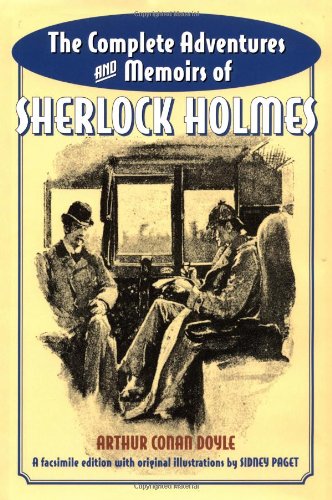
Sidney Paget undertook the job of illustrating Arther Conan Doyle’s Sherlock Holmes stories for The Strand Magazine in 1891. However, his hiring was a mistake. The editors had actually offered the job to his brother, Walter, another fine illustrator whose drawings eventually adorned the works of Shakespeare, Walter Scott, H. Rider Haggard, Daniel Defoe, and others. It proved to be a most fortuitous mistake for the Sydney Paget illustrations of the Holmes stories proved to be superbly unequaled.

Wrote James Montgomery in 1954, “It would be impossible to overestimate the influence that Paget exerted…on his interpretation of Holmes, Watson, and the golden time ‘where it is always 1895.’ From that day to this, no characterization, no other mood has been accepted by English readers, and when his untimely death in 1908 necessarily shifted his mantle to other shoulders, the artists who followed him — several of greater skill and reputation — were compelled to subordinate themselves to the Paget style in all essential particulars. It has been truly said that what Phiz did for Pickwick, Paget did for Sherlock Holmes.”

Here are examples of both men’s work. The first two are Walter Paget illustrations from, respectively, Treasure Island and King Solomon’s Mines. And the other two, of course, are Sidney Paget’s work for the Sherlock Holmes stories.


Tuesday, January 14, 2014

Conan Doyle Trivia

An early motorist and skier? On the same cricket team with J.M Barrie? Too fat to fight?

Rachel Ward has collected these and a few other nifty notes in an interesting article for the Telegraph, “Arthur Conan Doyle: 19 things you didn't know.”

Friday, March 09, 2012

A New Book from Conan Doyle?

Much more beloved than Sherlock Holmes to Arthur Conan Doyle were the heroes he established in his longer historical novels: heroes like Professor George Edward Challenger, Sir Nigel Loring, Brigadier E. Gerard and Micah Clarke.

Like so many, I am unable to share Doyle's opinion for I believe that Holmes, the superb detective of 221B Baker Street, stands as perhaps the greatest, most fascinating fictional character of all time.  Nevertheless, I do like Doyle's other fiction and have enjoyed many hours reading (and re-reading) the exploits of these other fellows.

Except for Micah Clarke, that is. The price of this rare book has always prohibited me from making his acquaintance.

Until now. For thanks to Project Gutenberg and Claire's Kindle, I am enjoying making Micah's acquaintance -- and not for the $90 (plus shipping) that I first found on Amazon, but for free.

Micah Clarke was Doyle's first entry into the field of historical fiction and so far I'm pretty impressed. I'm less than a third of the way through the novel and so the Monmouth Rebellion, the religious conflict which broke out in northern England in 1685 (and which provides the primary field of action for the novel), hasn't actually started yet. Still, several of the novel's characters have come into fine focus, adventures and dramatic situations have already occurred, and the prelude to the momentous conflict has been effectively described.

I'm excited to have a completely fresh reading from Conan Doyle. For historical detail, for superb characters and thrilling adventures, for insight into human nature and, let's remember, for exquisite writing, Conan Doyle must always rank high.

So, go ahead and see why Doyle was so perturbed that his great detective stole the limelight which he thought was more properly due to adventurers like Micah Clarke. Read it (for free) via Project Gutenberg.

Monday, October 20, 2008

Catching Up!

Among the stumbling blocks in my desire to keep current on The Book Den are the dramatic increase of activity in Vital Signs Ministries’ other cyberspace efforts, the extra time Claire and I now need to take care of my ailing mother (a joyful burden, I assure you) and, of course, my assumption of regular preaching duties down at Faith Bible Church in Omaha’s near south side.

But perhaps the greatest angst of the matter is just being so far behind with a decreasing chance of ever catching up.

Well, I may not be able to manufacture more hours in the day to overcome the first three difficulties but, doggone it if I can’t at least shake that last monkey off my back. So here's a post that covers (if only super quick) all the books from this last year I haven’t yet got round to.

Then maybe I can breathe again. So, here we go….

There was a handful of "modern" books that I managed my way through this year but few of them were very memorable. David Baldacci’s The Collectors was one of them. I picked it up in an airport for lack of anything better. If I remember correctly, it was passable but it wasn’t anything I’d recommend. I fared better with a couple of other airport purchases: P.D. James’ Death in Holy Orders and Clive Cussler’s Dragon. Cussler’s plots can be kinda’ wild but they’re very inventive, exciting and at least plausible within the framework of adventure fantasy he creates. Nice stuff -- somewhat reminiscent of Alistair MacLean.

Another modern novel that I’ve found in perusing this year’s reading list is Devil May Care by Sebastian Faulks. It’s the new (and from what I gather) “authorized” James Bond book. I checked it out from my local library after reading a couple of good reviews. Both compared it quite favorably with Ian Fleming, the original creator of Bond, but as I’ve never read any of Fleming’s work except the book he wrote for his kids, Chitty Chitty Bang Bang, I wasn’t able to judge. Perhaps Faulks gets to wear the mantle and produce more Bond novels. I'm happy for him but I don’t think I'll be among his readers. I didn’t find this one satisfactory. Maybe if I had read it on a plane...

2008’s reading included, naturally, the monthly selections of our ongoing literary society, the Notting Hill Napoleons. I’ve already commented on a couple of them in The Book Den this year: Victor Hugo’s Toilers of the Sea, which I liked, and Jessamyn West’s The Friendly Persuasion, which I also liked (though as a set of related short stories, not as a novel).

The NHN selections titles I didn’t cover were P.C. Wren’s Beau Geste, James Hilton’s The Lost Horizon (I’ve reviewed this in the Den a year ago), Anthony Trollope’s Dr. Thorne, Christopher Morley’s Parnassus on Wheels, Conan Doyle’s The Tragedy of the Korosko, H. Rider Haggard’s King Solomon’s Mines and Rafael Sabatini’s The Sea-Hawk. I found them all enjoyable and our discussions over them all were lively and thoughtful. Nevertheless, there were clear favorites for me: Parnassus and Sea-Hawk.

Still to come for this year’s Napoleons’ list? Nevil Shute’s Ruined City, Selected Stories by O. Henry (Barnes and Noble Classics Series) and Charles Dickens’ A Tale of Two Cities. The last one I've commented on before in this post.

My non-fiction reading seemed especially limited this year. I guess most of the time I would normally have spent with non-fiction (primarily history, culture and theology) was taken up instead with studying for sermons. But there were a few I managed to squeeze in. Four of them were part of Vital Signs' Book It! series; one was a selection of the Omaha Chesterton Society; and one was just pure pleasure reading. They were: Judging Thomas: The Life and Times of Clarence Thomas by Ken Foskett; America Alone by Mark Steyn; The Prince of Darkness by Robert Novak; The Grand Weaver by Ravi Zacharias, Infidel by Ayaan Hirsi Ali, and The Path to Rome by Hillaire Belloc. A few of those I did review in the Den here (Foskett, Zacharias, Ali which I talked briefly about over on Vital Signs Blog, and the one of this half dozen I’d most heartily recommend; namely, Novak’s compelling, fascinating autobiography).

Other non-fiction that I found time for included a richly detailed, exhaustively researched history by Alan Schom, One Hundred Days: Napoleon’s Road to Waterloo and one of the best biographies I’ve read in awhile, Fred Kaplan’s Dickens. Julian Symon’s Conan Doyle: Portrait of an Artist also fell in there sometime this summer but I wasn't too keen on it.

And, oh yes, a couple of non-fiction titles I found helpful in my preparations for my recent teaching stint in West Africa were The Christian Educator’s Handbook on Children’s Ministry by Choun and Lawson as well as Lawrence O. Richard’s A Theology of Children’s Ministry. But there's a rather limited audience for those last two, I’m afraid.

G.K. Chesterton reading is always popular around here and along with the casual reading of his essays this year, I also read his early novel, Basil Howe; his literary criticism, Tolstoy; and the essays collected in Brave New Family.

Finally, every year finds me re-reading some of my library’s dearest treasures and 2008 has been no exception. Among those favorites was a John Buchan tear I went on last winter. It consisted of Thirty-Nine Steps, Power-House, Greenmantle, Mr. Standfast, The Three Hostages, The Island of Sheep, and Huntingtower. There was also Oliver Twist by Charles Dickens and The Three Musketeers by Alexander Dumas tossed into the mix. I never tire of either author.

Okay then. My catch up post is complete. Well, pretty complete. I’m sure I’ve left out a couple of titles and I certainly haven’t done justice to any of them…but at least I’m caught up and can sleep soundly again. :)

Happy reading, guys.