Showing posts with label Language. Show all posts

Thursday, August 31, 2023

About Auden's Night Mail

Night Mail was commissioned for the United Kingdom’s documentary film of the same name which Auden was working on in 1936. It was determined by the producers that a spoken word poem would increase the film’s dramatic impact. They were right as the poem not only worked very well for the film, it quickly became one of the best loved of all Auden’s poems. 

And if you'd like to watch that original 24-minute documentary, do so right here.

Night Mail by W.H. Auden

This is the night mail crossing the Border,
Bringing the cheque and the postal order,

Letters for the rich, letters for the poor,
The shop at the corner, the girl next door.

Pulling up Beattock, a steady climb:
The gradient’s against her, but she’s on time.

Past cotton-grass and moorland boulder
Shoveling white steam over her shoulder,

Snorting noisily as she passes
Silent miles of wind-bent grasses.

Birds turn their heads as she approaches,
Stare from bushes at her blank-faced coaches.

Sheep-dogs cannot turn her course;
They slumber on with paws across.

In the farm she passes no one wakes,
But a jug in a bedroom gently shakes.

Dawn freshens, her climb is done.
Down towards Glasgow she descends,
Towards the steam tugs yelping down a glade of cranes
Towards the fields of apparatus, the furnaces
Set on the dark plain like gigantic chessmen.
All Scotland waits for her:
In dark glens, beside pale-green lochs
Men long for news.

Letters of thanks, letters from banks,
Letters of joy from girl and boy,
Receipted bills and invitations
To inspect new stock or to visit relations,
And applications for situations,
And timid lovers’ declarations,
And gossip, gossip from all the nations,
News circumstantial, news financial,
Letters with holiday snaps to enlarge in,
Letters with faces scrawled on the margin,
Letters from uncles, cousins, and aunts,
Letters to Scotland from the South of France,
Letters of condolence to Highlands and Lowlands
Written on paper of every hue,
The pink, the violet, the white and the blue,
The chatty, the catty, the boring, the adoring,
The cold and official and the heart's outpouring,
Clever, stupid, short and long,
The typed and the printed and the spelt all wrong.

Thousands are still asleep,
Dreaming of terrifying monsters
Or of friendly tea beside the band in Cranston’s or Crawford’s.

Asleep in working Glasgow, asleep in well-set Edinburgh,
Asleep in granite Aberdeen,
They continue their dreams,
But shall wake soon and long for letters,
And none will hear the postman’s knock
Without a quickening of the heart,
For who can bear to feel himself forgotten?

Friday, March 07, 2014

Old English Words We Could Still Use

Golly, who knew?

An ultracrepidarian is somebody who gives opinions on subjects they know nothing about…To groke means to gaze at somebody while they're eating in the hope that they'll give you some of their food…And a snollygoster is a a shrewd, unprincipled person, especially a politician.

Those are just a few of “13 Wonderful Old English Words We Should Still Be Using Today” that you can find over at Business Insider.

Zwodder? Grufeling? Fudgel? Go on over and find out.

Thursday, December 01, 2011

Really Good "Bad" Writing

Claire and I, former teachers that we are, got a big laugh out of this collection of Really Bad Analogies that came from stories written by high school students. I think you will as well. Remembering papers I've graded back in the day, I fear that a few of these lines may be "quite innocently" bad. But I'm sure you'll agree that most of them are so cleverly, exquisitely bad that the writer just had to have done it on purpose. Raymond Chandler, eat your heart out.

Let me drop in right here a few of my favorites and you can go on over and find yours.

* Her eyes were like two brown circles with big black dots in the center.

* He was as tall as a 6′3″ tree.

* He was as lame as a duck. Not the metaphorical lame duck, either, but a real duck that was actually lame. Maybe from stepping on a land mine or something.

* The lamp just sat there, like an inanimate object.

* He spoke with the wisdom that can only come from experience, like a guy who went blind because he looked at a solar eclipse without one of those boxes with a pinhole in it and now goes around the country speaking at high schools about the dangers of looking at a solar eclipse without one of those boxes with a pinhole in it.

* The young fighter had a hungry look, the kind you get from not eating for a while.

* The red brick wall was the color of a brick-red Crayola crayon.

* Fishing is like waiting for something that does not happen very often.

* They were as good friends as the people on “Friends.”

* It came down the stairs looking very much like something no one had ever seen before.

Friday, May 09, 2008

Wolfe on the Prowl

Here's a fascinating set of five vidcasts (courtesy of Uncommon Knowledge with Peter Robinson, Stanford University, and National Review Online) entitled "The Word According to Tom Wolfe." They are only about 6 minutes long but each one is yet riveting and thoroughly enjoyable.

Tom Wolfe, of course, is the author of numerous bestselling works of fiction and non-fiction. Among these are The Kandy-Kolored Tangerine-Flake Streamline Baby (1965), The Pump House Gang (1968), The Electric Kool-Aid Acid Test (1968), Radical Chic & Mau-Mauing the Flak Catchers (1970), The Right Stuff (1979), The Bonfire of the Vanities (1985), A Man in Full (1998), Hooking Up (2000), and I Am Charlotte Simmons (2004). He is at present working on a novel due in 2009, called Back to Blood.

In the first installment of "The Word According to Tom Wolfe," he discusses with Peter Robinson the written word in its various popular forms and describes the novel as a genre "dying a horrible death." He talks about his latest book still in progress. The second continues with Wolfe talking a bit about his own work (he suggests his novels are perhaps more journalism than literature) and about one crowd of dilettantes he definitely doesn't write for, the “charming aristocracy.”

In chapter three of "The Word According to Tom Wolfe," the writer that many think is America's greatest of the modern era, discusses the power of the word to change history and culture. He looks briefly at Darwin, Marx, Freud, and Edmund Wilson as examples. The fourth interview segment expands on evolution. Wolfe, not a card-carrying Darwinist by any stretch (see this Book Den post) argues the differences between man and animals are most dramatically highlighted by the matter of language.

And, finally, in the fifth and last chapter, Peter Robinson elicits provocative statements from Wolfe about Eisenhower, Reagan, patriotism, and George W.Bush.

Really interesting stuff.

Saturday, August 18, 2007

Waugh on Muggeridge: An Early (and Profoundly Prescient) View

It is always of interest when a couple of one's favorites interact. Thus, I've enjoyed very much sharing with you here at The Book Den a delightful letter from Max Beerbohm to G.K. Chesterton, the radio announcement from Lowell Thomas on the death of Chesterton, the description of the meeting of Malcolm Muggeridge and Francis Schaeffer, and even the item I recently posted over on Vital Signs Blog linking Chuck Norris and Elvis Presley.

But printed below is a particularly meaningful contact, one that I appreciate on several levels. 1) It involves the contact of two of the most talented and perceptive writers in English letters, Evelyn Waugh (pictured at upper left) and Malcolm Muggeridge (shown at lower right). 2) It reveals the truly remarkable flair Waugh had both for literary interpretation and moral judgment. And 3) It shows some of the seeds of truth and longing that God planted in the young hedonist that Muggeridge was, seeds which would, years later, find fruition in his embrace of Christianity.

Really fascinating stuff.

So here, from the May 27th issue (1938) of the Spectator is Evelyn Waugh's review of Malcolm Muggeridge's latest book at the time, In a Valley of This Restless Mind.

Desert Islander

Fifty years ago, to have said of a book - on a serious subject, by an experienced writer, under the imprint of a reputable firm - that it was grammatical would have been to damn it with faint praise; nowadays it is an extravagant expression of surprise and gratitude. There are, no doubt, many reasons for this general decay of literary decency - the popular heresy that resemblance constitutes identity; pernicious early association with teachers who, instead of knocking the elements of syntax into their pupils' pates, regard 'English' classes as an opportunity to inflame their imaginations; later, the habit of the typewriter and the stenographer; the final annulment of the long-estranged marriage of popular journalism and literature. Whatever the influences, Mr Muggeridge has escaped them, and it is a pleasure to welcome him into that very small company of writers whose work would escape the red ink of the Victorian governess. His new book gives the reader the hope that no two words mean exactly the same to him; the punctuation, though not always orthodox (commas before ands), is usually consistent; with the exception of three painful conjunctival uses of 'like', there are no barbarities of grammar; there is an abundance of literary allusion and concealed quotation to flatter the reader's knowledge. It is, in fact, a highly unusual and welcome piece of workmanship.

The approval of the Victorian governess would, however, be rigidly limited to the book's style. Much of the subject matter would strike her as obscene and blasphemous and may even now offend the fastidious. That warning should be given before the book is commended without reserve. But it is a warning to the reader, not a criticism of the writer, because the indecent passages of the book are not blemishes; they are an organic part of it, necessary to its life.
It is not an easy book to describe. It has affinities, in form, with Candide and, in temper, with Voyage au bout de la nuit. It is a highly symbolized and stylized autobiography whose range includes satirical reportage and something very near prophecy.

'What are you interested in?' asks the literary editor.

I said I was interested in Lust and in Money and in God.

'I've seen a book lying about that might be suitable. Short notice if worth it.'


These three are the topics of Mr Muggeridge's inquiry. Several incidents -one very brilliantly and ruthlessly describes a passage with an intellectual and humane wanton - illustrate his attitude to lust, which is that of the surfeited and rather scared Calvinist. No one with an acute moral sense could ta
ke these passages for pornography; they will, however, be distasteful to those who shirk the theological implications of the word 'Lust'; to those, in particular, who like something 'spicy'. They are very dry and gloomy episodes reminiscent of the When lovely woman stoops to folly' passage in The Waste Land. In brief, what Mr Muggeridge has discovered and wishes to explain is the ancient piece of folk-wisdom that Lust and Love are antithetical and that Lust is boring.

His conclusions about money are that it has become the symbol in terms of which the greater part of mankind measure happiness and well-being; that it is in fact trash. The hero for a few delirious weeks enjoys the favours of Mammon, who is symbolized by a 'Sir John'; he is abandoned as capriciously as he has been adopted. He goes on a quest of money among his friends, finds a little and deliberately throws it away as worthless.


His quest for God, for 'Purity of Heart', does not take him very far. He meets an urbane archdeacon, a theatrical Anglo-Catholic monk, a revivalist, a psychoanalyst, an Indian theosophist, a rose-growing rector and finds that none of them are
of any help to him. His is that particularly English loneliness of a religiously minded man suddenly made alive to the fact that he is outside Christendom.

The conclusions he reaches, indeed, are sound and topical; he has arrived at negative truths by a highly interesting process. Three other major characters move through the types which throng the book - the left-wing political journalist, the perverted novelist and a mysterious and horrible Mrs Angel; all these are drawn with a precision and confidence that suggest portraiture. Mrs Angel, decaying, restless, tenacious of life, actuated by nothing except a futile curiosity, is the most remarkable of three triumphs of writing which, alone, would make the book valuable.


What has been written above may suggest the temper of the book; it gives little idea of the form. It is written in the first person but it makes no attempt at autobiography in the chronological or informative sense. The first words are, 'Looking for God, I sat in Westminster Abbey'; the last: 'I, a man, an atom of love, was soon to die, as every other man and beast and plant and stone, the very universe, must die.' Thus, in a sense, the whole order of the book has been turned topsy-turvy. Between these grave statements are included: a very good, brief letter describing a domestic holiday in Egypt, a dream of a dying wife, an analysis of newspaper reading, great gushes of rather Dickensian compassion quickly stifled; there is a scene of street-corner oratory which deserves extensive quotation:

'We are all in the same plight,' I shouted, 'all strangers in a strange land.'
One or two gathered round... They were menacing. Someone gave me a push. 'You shut your mouth,' one or two of them grumbled.

'Ladies and gentlemen,' I began, to reassure them, 'I am here tonight to ask you to give your votes...'

Now they were easier. They stood back.

'Comrades,' I began, 'you know what...hunger is...You have a Vote; cast it...'

'Hear, hear!' one or two shouted.

'May I suggest,' I went on, warming, 'that you become registered readers of the Daily Express. It's first with the news;... its motto is service; it costs only a penny.'
I took off my hat and they began to feel in their pockets.


This passage, greatly compressed in quotation, is typical of the author's method; the sudden superb swoop into nonsense is, for the man of words, one of the bitterest denials possible; the denial that anything is more worth saying than anything else.


The book combines the sense of futility of the 'twenties' with the serious-mindedness and world-conscientiousness of the 'thirties'. I suggest that in the next ten years we shall see a number of imitators, as its spirit of disillusionment spreads among the ideologues. But it is too much to hope that we shall see many as well written.


(Source: The Essays, Articles and Reviews of Evelyn Waugh. 1983. Little, Brown and Company)

Monday, June 18, 2007

Somerset Maugham on the World's Greatest Novelists


The four greatest novelists the world has ever known, Balzac, Dickens, Tolstoy and Dostoyevsky, wrote their respective languages very indifferently. It proves that if you can tell stories, create character, devise incidents, and if you have sincerity and passion, it doesn't matter a damn how you write.

Somerset Maugham (1874-1965)

Friday, April 13, 2007

Why Can't Americans Read, Write or Think?

After sober and judicious consideration, and weighing one thing against another in the interests of reasonable compromise, H. L. Mencken concluded that a startling and dramatic improvement in American education required only that we hang all the professors and burn down the schools. His uncharacteristically moderate proposal was not adopted. Those who actually knew more about education than Mencken did could see that his plan was nothing more than cosmetic and would in fact provide only an outward appearance of improvement. Those who knew less, on the other hand, had somewhat more elaborate plans of their own, and they just happened to be in charge of the schools.

Those who knew less, to be specific, were the members of the National Educatio
n Association's Commission on the Reorganization of Secondary Education, a.k.a. The Gang of Twenty-seven, now long forgotten but certainly not gone. They builded better than they knew, and their souls go marching on in every school in America today. The Commission was established in 1913, the year that also brought us the income tax. Many of its members were functionaries of school bureaucracies, from the United States Commissioner of Education himself down through supervisors and associate superintendents and principals and even a high school inspector, whatever that was, to no less a personage than a senior educational secretary of the YMCA. Professors and assistant professors of education represented the higher learning. One of them was chairman of the committee on mathematics, naturally, while the committees on lesser disciplines, notably classical and modern languages, were directed by high school teachers. The stern sciences were served by a professor of education, while the smiling sciences like social studies and the other household arts were overseen by federal bureaucrats. In the whole motley crew there were no scientists, no mathematicians, no historians, no traditional scholars of any sort.

That was surely no accident, for it seems to have been an article of the Commission's unspoken agenda to overturn the work of an earlier NEA task force that had been made up largely of scholars, the Committee of Ten, called together in 1892 and chaired by Charles W. Eliot, then president of Harvard University. That committee had come out in favor of traditional academic study in the public schools, which they fancied should be devoted to the pursuit of knowledge and the training of the intellect. But what can you expect from a bunch of intellectuals?...

Thus begins Chapter 4 ("The Seven Deadly Principles") of Richard Mitchell's classic work, The Graves of Academe: Why Can't Our Nation Read, Write, Cipher or Think? a book which Clifton Fadiman described as, "of the highest importance. . . a slashing and irrefutable attack, not on teachers, but on the educational establishment that trains them--and which has trained us. " Fadiman concluded, "Mr. Mitchell is invaluable. Also -- he's enormously entertaining."

George Will spoke of the late Mr. Mitchell's writings as a "cleansing fire" whereas the erudite journalist and grammarian Edwin Newman remarked, "If English is saved, he will be one of its saviors."

I have long appreciated Richard Mitchell, especially The Graves of Academe, Less Than Words Can Say, and The Leaning Tower of Babel and I heartily recommend reading him as a way to learn not only the English language but the processes of intelligent thought. His books are frequently available in used book shops and public libraries. But you can also utilize the unique and authorized web page, The Underground Grammarian, where you can read Mitchell's works online.

Wednesday, September 13, 2006

Some Fun with Your Greek and Hebrew Studies

My old pal, Dana Hall, now living in Colorado, sent along a couple of fun links, especially for those of us who once entertained hopes of mastering the Koine Greek and Hebrew languages. In my case, Greek was hardly even attempted, whereas Hebrew...well, Hebrew was hardly even imagined. Dana has done much better.

Anyway, here's Dr. Seuss Learns Greek and over here is Abbot and Costello Learn Hebrew. Enjoy.

Tuesday, July 25, 2006

On Language, the Logos and the Origin of Words

I am fascinated by language...its forms and functions, its beauty and rhythm, its complexity and history.

And though this attraction certainly relates (as I’ve been told several times) to my occupation as a speaker and writer, I believe even more relevant to my deep interest in language are my avocations as a reader and conversationalist.

And, of course, not to be taken lightly, is the connection of language to my Christian faith. After all, Christianity is a religion revealed through the written word; the study of which involves careful attention to definitions, grammar, and comparative usage. Indeed, the gospel of John presents Jesus Himself as the Logos, the eternal Word of Life Who communicates (and, by His sacrifice on Calvary, secured) our salvation.

So, this fascination with language has several profound sources. Little surprise then that it has left many ongoing effects as well.

Among the areas of keen interest thus produced are my adventures in the history of English words and phrases. My library includes several wonderful books of this type. Among them are Brewer’s Dictionary of Phrase and Fable revised by John Freeman, A Dictionary of Word and Phrase Origins by William and Mary Morris, A Hog on Ice and Other Curious Expressions by Charles E. Funk, and the more intensive volume, A Concise Etymological Dictionary of the English Language first published in 1882 by the Rev. Walter W. Skeat.

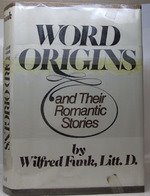
A recent (and very welcome) addition to this little group is Word Origins and Their Romantic Stories by Wilfred Funk. This 1950 book came my way last month for $1 at a used book table at the 25th Annual G.K. Chesterton Conference in St. Paul, Minnesota. Wow -- comparing that single buck to the immense enjoyment I’ve already received from the book almost makes me feel like I should turn myself in.

Here’s a little taste of Funk’s charming perspective on etymology…

“It is unfortunate, in a way, that we learn words when we are so very young, for as we become adult we take these strange symbols for granted. By then there is little of mystery in them for us. We are apt to think vaguely that words just happened and were always so. We have no sharp feeling that they were born much as babies are born. That they are vibrant with life and are always changing. That they grow up and often, like us, take on the greater responsibilities that go with maturity. And that, by the end of their days, for die they often do, they will frequently have life histories as long and distinguished as human biographies in a copy of Who's Who.

“To know the past of an individual helps us to understand him the better. To know the life history of a word makes its present meaning clearer and more nearly unforgettable. And besides all this, the stories in and of themselves are often packed with romance and adventure and lead us far away into the fields of mythology and history and of great names and great events. Words truly are little windows through which we can look into the past.”

Friday, July 14, 2006

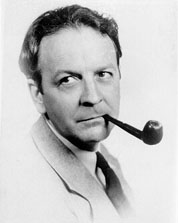
New Entry in Denny's "Mystery Writers Honor Roll" -- Raymond Chandler

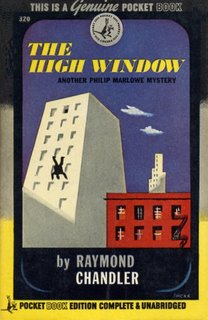
A few months back I posted here my Mystery Writers Honor Roll, never thinking that after a lifetime of reading in that genre, I might find a need to revise that list. Well, I'm doing so unabashedly because I recently concluded a Raymond Chandler jag in which I devoured the Library of America edition which featured him. That closely-packed, 1200 page book contained three Chandler novels (The Big Sleep; Farewell, My Lovely; and The High Window) along with thirteen stories published in American magazines in the thirties. Those magazines were primarily “pulps” like Black Mask and Dime Detective.

I had once read The Big Sleep but it hadn’t left any strong effect and all the others were completely new to me. But they certainly struck a very responsive chord in the last couple of weeks, thereby winning Chandler a welcome place in the Honor Roll.

Chandler is a terrific mystery writer though his style leans more to the hard-boiled detective and police procedural genres than the traditional mystery. In that sense, he would rank alongside Erle Stanley Gardner in my list. But Chandler strives for higher goals than Gardner in his writing – simple entertainment and well-paying profits are not enough. And though Chandler himself was never satisfied with his work, there were many who considered him not only a superb detective novelist but a fine literary craftsman as well. In that company were Gardner himself, T.S. Eliot, W.H. Auden and Evelyn Waugh.

Raymond Chandler’s stories are detailed, dark, and though filled with action, they are also cerebral in theme and complex in plot. The prose is terse, often delicately timed to the action being described. In this, he shows a poetic skill very rare in the form. There is also a high regard for realism in his descriptions of characters, dialogue and setting and he manages all of them extremely well.

His world, of course, is filled with the thugs, cops, molls and saps of the underworld and there’s plenty of blackmail, corruption, robbery, bluffs, gunplay, fisticuffs, car chases and car crashes, mysterious beauties, heavy villains, seedy scenes and tough talk. But Chandler's protagonists always blaze through to a triumphant ending with justice well served. And if the heroes heads aren’t always intact by the closing sentence, their principles are.
So, I repeat; Raymond Chandler has been warmly inducted into my Mystery Writers Honor Roll and for those of you interested in the genre, I’m recommending you give him a try. You’ll find very well drawn characters, inventive yet easily believable plots and a concise, rhythmic use of simple sentences.

And speaking of sentences -- I confess I was as captivated by the wit and imagination of those uniquely descriptive phrases known as “Chandlerisms” as anybody else. In fact, here are just a few of the many I noted along the way:

“There was a desert wind blowing that night. It was one of those hot dry Santa Anas that come down through the mountain passes and curl your hair and make your nerves jump and your skin itch. On nights like that every booze party ends in a fight. Meek little wives feel the edge of the carving knife and study their husbands’ necks. Anything can happen. You can even get a full glass of beer at a cocktail lounge.”--“Red Wind”

“The knocking sounded again... I went over and opened the door—without a gun. That was a mistake.”--“Red Wind”

“His eyes measured me for a coffin...”--“Red Wind”

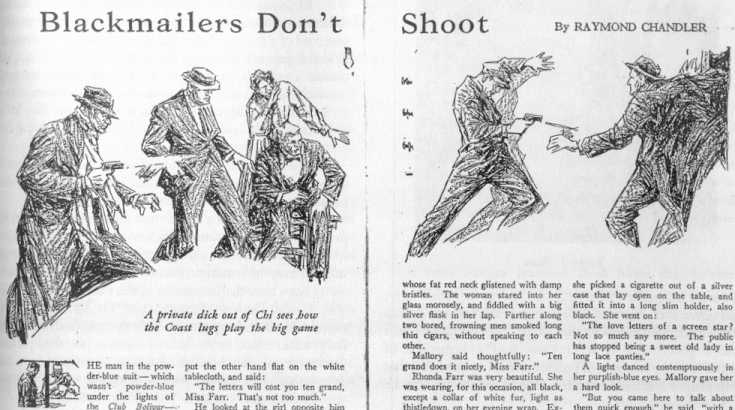
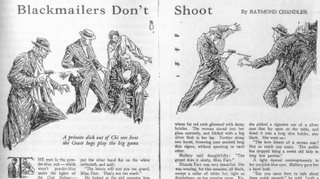
“Rhonda Farr...held up her hand, the one with the cigarette holder, looked at it, posing. It was a beautiful hand, without a ring. Beautiful hands are as rare as jacaranda trees in bloom, in a city where pretty faces are as common as runs in dollar stockings.”--“Blackmailers Don’t Shoot”

Ricchio went on: ‘We’ll play clean. Our racket wouldn’t be worth a squashed bug if we didn’t. You’ll play clean too. If you don’t your shamus will wake up on a pile of dirt. Only he won’t wake up. Get it?’--“Smart-Aleck Kill”

"I'm an occasional drinker, the kind of guy who goes out for a beer and wakes up in Singapore with a full beard." --"The King in Yellow"

‘”If you want trouble,’ he said, ‘I come from where they make it.’”--“The King in Yellow”

“I didn’t say anything. I was way past the age when it’s fun to swear at people you can’t hurt."--“Finger Man”

“Dorr raised his head a few inches and looked at me with his mouth slightly open. He had beautiful teeth, but they hadn’t grown in his mouth. --“Finger Man”

“As a bluff, mine was thinner than the gold on a week-end wedding ring." --“Finger Man”

“Shoes dropped on cement and a smaller spotlight stabbed at him sideways from the end of the billboards. Behind the spot a casual voice spoke: ‘Don’t shift an eyelash, bud. You’re all wrapped up in law.’”--“Pick-Up on Noon Street”

“She was a tall, seedy, sad-eyed blonde who had once been a policewoman and had lost her job when she married a cheap little check-bouncer named Johnny Horne, to reform him. She hadn’t reformed him, but she was waiting for him to come out so she could try again.” --“Goldfish”

"I needed a drink, I needed a lot of life insurance, I needed a vacation, I needed a home in the country. What I had was a coat, a hat and a gun."-- Farewell, My Lovely

“This car sticks out like spats at an Iowa picnic.”-- Farewell, My Lovely

“Who is this Hemingway person at all? A guy that keeps saying the same thing over and over until you begin to believe it must be good.”-- Farewell, My Lovely

“But me not buts. I make a sop of you. I’ll drown you in a butt of Malmsey wine. I wish I had a butt of Malmsey wine to drown in. Shakespeare. He knew his liquor too.”-- Farewell, My Lovely
‘"She's a charming middle age lady with a face like a bucket of mud and if she's washed her hair since Coolidge's second term, I'll eat my spare tire, rim and all."’ -- Farewell, My Lovely

"The house itself was not so much. It was smaller than Buckingham Palace, rather gray for California, and probably had fewer windows than the Chrysler Building. I sneaked over to the side entrance and pressed a bell and somewhere a set of chimes made a deep mellow sound like church bells. A man in a striped vest and gilt buttons opened the door, bowed, took my hat and was through for the day."-- Farewell, My Lovely

“She had a voice you could crack a brazil nut on.”-- The Lady in the Lake

"From thirty feet away she looked like a lot of class. From ten feet away she looked like something made up to be seen from thirty feet away."--The High Window

Monday, July 03, 2006

A Conversation On Words

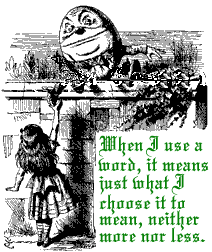
... `When I use a word,' Humpty Dumpty said in rather a scornful tone, `it means just what I choose it to mean -- neither more nor less.'

`The question is,' said Alice, `whether you can make words mean so many different things.'

`The question is,' said Humpty Dumpty, `which is to be master - - that's all.'

Alice was too much puzzled to say anything, so after a minute Humpty Dumpty began again. `They've a temper, some of them -- particularly verbs, they're the proudest -- adjectives you can do anything with, but not verbs -- however, I can manage the whole of them! Impenetrability! That's what I say!'

`Would you tell me, please,' said Alice `what that means?`

`Now you talk like a reasonable child,' said Humpty Dumpty, looking very much pleased. `I meant by "impenetrability" that we've had enough of that subject, and it would be just as well if you'd mention what you mean to do next, as I suppose you don't mean to stop here all the rest of your life.'

`That's a great deal to make one word mean,' Alice said in a thoughtful tone.

`When I make a word do a lot of work like that,' said Humpty Dumpty, `I always pay it extra.'

`Oh!' said Alice. She was too much puzzled to make any other remark.

`Ah, you should see `em come round me of a Saturday night,' Humpty Dumpty went on, wagging his head gravely from side to side: `for to get their wages, you know.'

(Alice didn't venture to ask what he paid them with; and so you see I can't tell you.)

`You seem very clever at explaining words, Sir,' said Alice. `Would you kindly tell me the meaning of the poem called "Jabberwocky"?'

`Let's hear it,' said Humpty Dumpty. `I can explain all the poems that were ever invented -- and a good many that haven't been invented just yet.'

This sounded very hopeful, so Alice repeated the first verse:

`Twas brillig, and the slithy toves
Did gyre and gimble in the wabe;
All mimsy were the borogoves,
And the mome raths outgrabe.

`That's enough to begin with,' Humpty Dumpty interrupted: `there are plenty of hard words there. "Brillig" means four o'clock in the afternoon -- the time when you begin broiling things for dinner.'

`That'll do very well,' said Alice: and "slithy"?'

`Well, "slithy" means "lithe and slimy." "Lithe" is the same as "active." You see it's like a portmanteau -- there are two meanings packed up into one word.'

`I see it now,' Alice remarked thoughtfully: `and what are "toves"?'

`Well, "toves" are something like badgers -- they're something like lizards -- and they're something like corkscrews.'

`They must be very curious looking creatures.'

`They are that,' said Humpty Dumpty: `also they make their nests under sun-dials -- also they live on cheese.'

`Andy what's the "gyre" and to "gimble"?'

`To "gyre" is to go round and round like a gyroscope. To "gimble" is to make holes like a gimblet.'

`And "the wabe" is the grass-plot round a sun-dial, I suppose?' said Alice, surprised at her own ingenuity.

`Of course it is. It's called "wabe," you know, because it goes a long way before it, and a long way behind it -- '

`And a long way beyond it on each side,' Alice added.

`Exactly so. Well, then, "mimsy" is "flimsy and miserable" (there's another portmanteau for you). And a "borogove" is a thing shabby-looking bird with its feathers sticking out all round -- something like a live mop.'

`And then "mome raths"?' said Alice. `I'm afraid I'm giving you a great deal of trouble.'

`Well, a "rath" is a sort of green pig: but "mome" I'm not certain about. I think it's short for "from home" -- meaning that they'd lost their way, you know.'

`And what does "outgrabe" mean?'

`Well, "outgribing" is something between bellowing and whistling, with a kind of sneeze in the middle: however, you'll hear it done, maybe -- down in the wood yonder -- and when you've once heard it you'll be quite content...

Monday, January 09, 2006

Book Words: Those Extant and Those Needed

You’ve heard of bibliophiles. They’re book lovers, the Latin word being a composite of “biblio” (book) and "philo" (love). But how about a few other bibliotypes to add to your vocabulary?

There's a bibliographe, a person who writes about books, and the bibliophobe, one who harbors an irrational fear of books. But did you know there are words for those who read too much (bibliobibuli); a person who hides books (bibliotapbe); people who rip the pages from books (biblioclasts); and even the overactive guy or gal who throws book around (biblioriptos). Amazing, huh? But this isn't the end — not by a long shot.

A bibliognoste is a person learned in the minute details of a book's publication like colophons, editions, dates and place printed, and who printed it. A bibliomane is an indiscriminate accumulator of books. There's a few of those around certainly. A bibliolestes is a book-thief while a bibliophtbor is even worse, a book ravager or destroyer. Yipes. There's even a word (bibliopbage) to describe the foolishly famished fellow who eats books! No kidding.

Yet with all of these nifty words available, I'd like to suggest the adoption of a few more — words that are necessary to cover the whole range of book-oriented activity.

For instance, what about the young wife who suffers from bibiloemeril, a love of cookbooks? Or the politician afflicted with bibliobiden, the use of books for purposes of plagiarism? And we should probably have a word to represent the common enough practice of using books from one's shelf (or closet) to give as a present when you haven’t had time to go shopping for something else. Let's go with biblioregiftei.

A few others that I think serviceable:
* Bibliosupportos — an inventive person who uses a book to replace a missing couch leg.
* Bibioinsecticide — one who uses books to squash bugs.
* Bibliopest — someone who reads only one book a year but adamantly insists that all her friends read it also because "it's absolutely the best book I've read all year!"
* Bibiocorsagini — a young woman who uses a book to press her prom flowers.
* Bibliocsi — the unwitting criminal who, in the process of committing a felony, leaves his epithelials or other identifying evidence on a book.
* Bibiloliar — the person who claims they have read Lolita, Peyton Place, or Lady Chatterley’s Lover for the book's literary qualities.

And before we leave this etymological enterprise concerning books, I also have a few additional bibliophobe categories to recommend. After all, I've never really come across a person who is afraid of books in general. However, I can see the need for more particular book-related phobias. Among them?

* The fear of long books. This is quite prevalent among students (and a few members of our literary society);
* The fear of the inter-library loan process;
* The fear of coming across in a book quotations or phrases which are written in another language;
* The fear of disappointment one experiences when he or she goes to see a Hollywood version of a treasured book;
* The fear of being asked an opinion about a book given as a gift but which was actually tossed (unread) into a box in the basement;
* The fear of receiving books from an e-Bay vendor that are advertised in "mint condition" but which probably are not;
* The fear experienced when a Mom asks her high school son, "So, why don't you ever bring any books home, dear?"

Feel free to start sprinkling these new book-oriented words into your vocabulary. You'll find that your friends will be very impressed to see what a bibliohipster you really are.

Saturday, April 16, 2005

The Elegant, Eloquent Ngaio Marsh

In the Golden Age of Mystery Novels, a few names stand above all others: Agatha Christie, Dorothy Sayers, Erle Stanley Gardner, Margery Allingham, Ellery Queen, John Dickson Carr, Leslie Charteris, Josephine Tey, and Ngaio Marsh. Of that company, I especially enjoy Sayers' atmosphere; Carr's incredibly clever plots; Gardner's fast-paced, hard-boiled Perry Mason; and Charteris' classic rogue, the Saint. Treasures all.

But for the sheer beauty and power of language, I must go with Ngiao Marsh, the New Zealander whose Roderick Alleyn mysteries stand as my favorites of the Golden Age. Clicking on the title of this post will take you to one of several Ngiao Marsh sites on the web. Avid mystery fans will find it of interest, no doubt. But there's no substitute for simply trying her work. And to encourage you to do so, I print here a sample. It is the opening of Singing in the Shrouds, a novel I just finished a couple of nights ago. The plot of this 1958 mystery, I must admit, is far from being her best. Nevertheless, even when the mystery itself stumbles a bit, Marsh's insightful, poetic use of the language never does. It is why I enjoy her so.

"In the pool of London and further east all through the dockyards the fog lay heavy. Lights swam like moons in their own halos. Insignificant buidlings, being simplified, became dramatic. Along the Cape Line Company's stretch of wharfage the ships at anchor loomed up portentously:Cape St. Vincent, Glasgow. Cape Horn, London. Cape Farewell, Glasgow . The cranes that served these ships lost their heads in the fog. Their gestures as they bowed and turned became pontifical.

Beyond their illuminated places the dockyards vanished. The gang loading the Cape Farewell moved from light into nothingness. Noises were subdued and isolated and a man's cough close at hand was more startling than the rattle of winches.

Police Constable Moir, on duty until midnight, walked in and out of shadows. He breathed the soft cold smell of wet wood and heard the slap of night tide against the wharves. Acres of acres of shipping and forests of cranes lay around him. Ships, he thought romantically, were, in a sort of way, like little worlds. Tied up to bollards and lying quiet enough but soon to sail over the watery globe as lonely as the planets wandering in the skies. He would have liked to travel. He solaced himself with thoughts of matrimony, promotion, and when the beat was getting him down a bit, of the Police Medal and sudden glory. At a passageway between buildings near the Cape Farewell he walked slower because it was livelier there. Cars drove up; in particular an impressive new sports car with a smashing redhead at the wheel and three passengers, one of whom he recognized with interest as the great television personality Aubyn Dale. It was evident that the others, a man and a woman, also belonged to that mysterious world of glaring lights, trucking cameras, and fan mail. You could tell by the way they shouted 'Darling' at each other as they walked through the passageway.

P.C. Moir conscientiously moved himself on. Darkness engulfed him, lights revealed him. He had reached the boundary of his beat and was walking along it. A bus had drawn up at the entry to the waterfront and he watched the passengers get out and plod, heads down and suitcases in hand, towards the Cape Farewell - a lush bosomy lady and her friend, two clergymen, a married couple, a benevolent-looking gentleman, a lovely young lady with a miserable expression, and a young gentleman who lagged behind and looked as if he'd like to ask her to let him carry her luggage. They walked into the fog, became phantoms, and disappeared down the passageway in the direction of the wharf."

Oh yeah. Dame Ngiao Marsh knew how to write! Give her a try or, if like me, you've enjoyed her in the past, grab a used paperback of her's at your nearest old bookshop, and start enjoying her all over again!

Wednesday, April 13, 2005

William Tyndale & the English Bible

Erasmus, the great humanist scholar of the late Middle Ages performed one of the most important projects of his time when he published an entire Greek New Testament in a lucid translation which was true to the original manuscripts. Though himself a quiet and moderate man, a Catholic who had desires for only modest changes in the Church, his new translation would become a key spark for the Reformation throughout Europe.

In particular, a young priest and language scholar in England took Erasmus’ New Testament to his very heart. He was William Tyndale, a man who would later testify that he found Jesus Christ in that New Testament and, depending upon Christ's mercy, Tyndale dedicated his life to producing the Holy Scriptures in English for his own people.

Tyndale’s great vision, however, was opposed by strictly and ruthlessly applied laws prohibiting the translation of the Bible into the language of the people. Indeed, parents had been burned at the stake simply for teaching their children the English version of the Lord’s Prayer and the Ten Commandments.

But God honored William Tyndale’s noble desires and the brave, diligent, prayerful work it required to bring them to pass. The Bible was translated into English and disseminated throughout the country. And though Tyndale paid the ultimate price, being martyred by strangulation and burning in October 1536, he considered his life's work a wonderful investment for his eternity.

The Bible in our own language -- we have heroes to thank and a heritage to treasure. And a Bible we should be reading much more than we do.